Monday, March 17, 2008
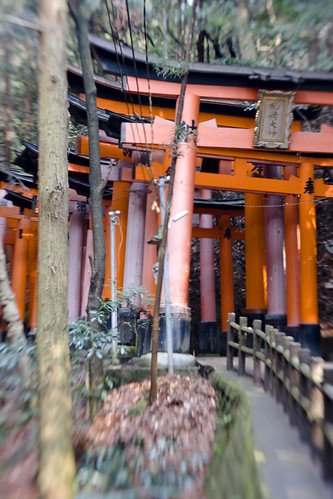
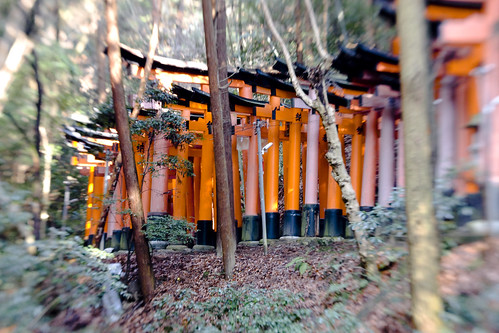
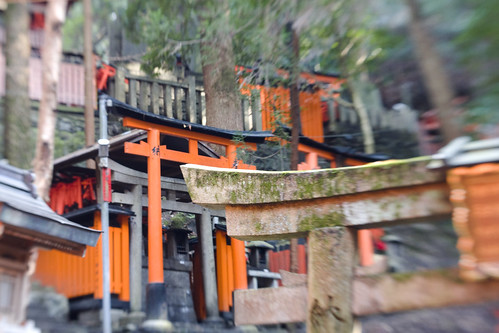
Fushimi Inari Taisha 伏見稲荷大社
Homepage (in Japanese) 伏見稲荷大社
Friday, March 14, 2008
Kyoto's Cloud City
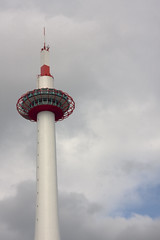
Built in 1964 at a height of 131m the very retro, often disparaged Kyoto tower has always been an icon of an aesthetic of Japanese design that doesn't get much play in the west or Japan. It seems that all the major cities of Japan need a tower of some sort and all them feature prominently in their town's iconography but Kyoto tower, even-though it's most likely the first thing you'd notice leaving Kyoto station, is almost ignored from the cities self identification. During my study abroad days none of my teachers or fellow students liked it either. I guess I'm in the minority on this issue. No matter. It reminds me of Cloud City from The Empire Strikes Back and the idea that Lando is up there totally just makes it seem cooler to me.
-Kyoto Tower is located across the street from the main exit of JR Kyoto Station.
-The trip to the top costs ¥770
-Open all year
-Operating Hours are 9:00-21:00
The building underneath the tower has a hotel, bathhouse(!?!?), restaurants, cafes, omiyage shops. I actually haven't made my way to the top of the tower yet, so I'll have to go up, check out the bathhouse and report back about all that at Kansai Onsen Review.
Kyoto Tower homepage (in Japanese)
kyoto-tower.co.jp/kyototower/index.html
Monday, February 25, 2008
Sanda at Night
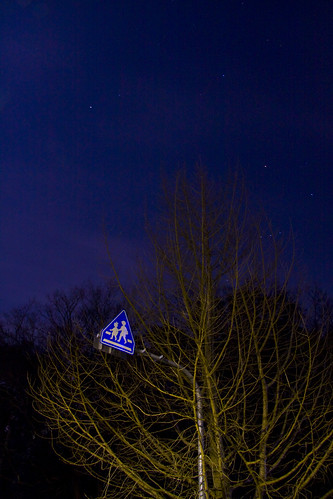
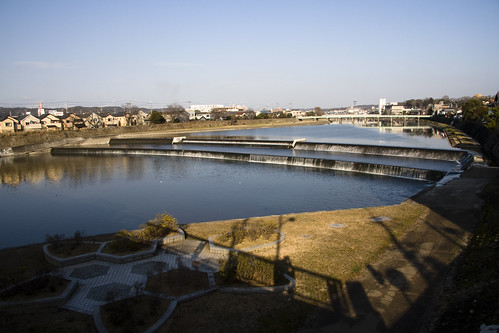
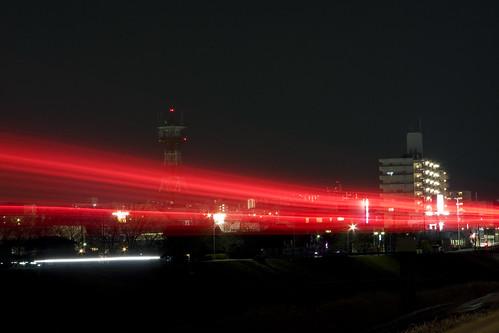
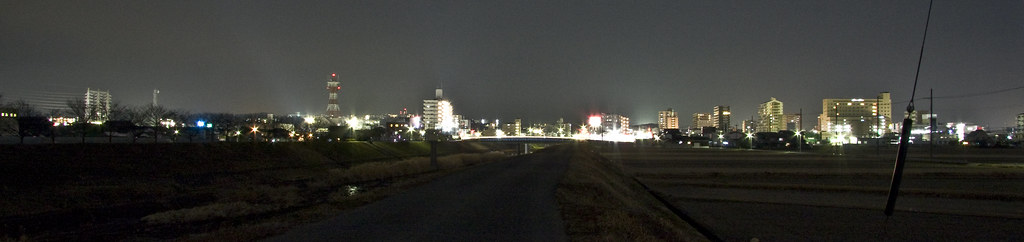
Before moving to digital I use to take most of my photos at night. Thanks to a full moon last week, and the chance to borrow a tripod, I headed out to take some photos. The full set is here.
Discarded Bike Locks in Umeda
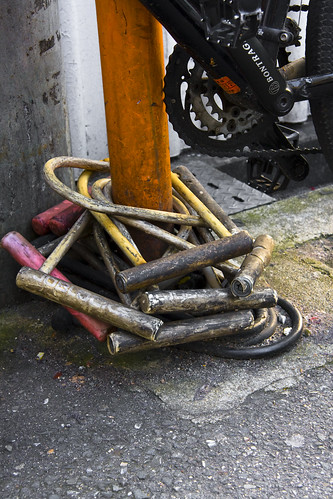
A common sight in most American cities, left over bike locks are not so common in Japan. Most people don't need to lock their bikes to something due to rarity of bike theft, or they can't do to the lack of anything to lock their bikes to. In downtown Osaka (Umeda) however, locking your bike to something would be a good idea--if you can find a place to lock your bike!
Monday, February 18, 2008
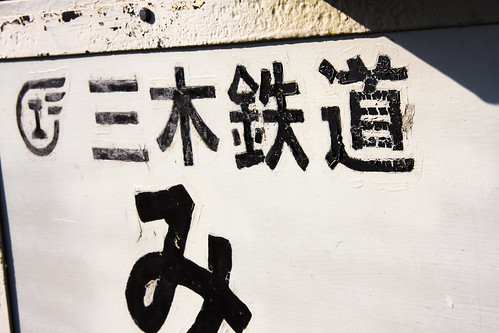
The Death and Life of Japanese Railways
I have some possible hypothesis for this closure. Is it the aftermath of an overbuilt national infrastructure that cannot support itself? Was this the eventual outcome for the line, but delayed by making it non-profit to lessen public outcry? Is this line just geographically un-profitable? I believe these three factors all played a major role in the railway’s decline. The pressure from the for-profit and much more efficient--albeit quite expensive--Kobe Electric Railway (Shintetsu) also helped exacerbated the situation. (Shintetsu runs more directly towards Kobe and Osaka, the largest local population centers and most likely the direction most residents of Miki would be traveling. The Miki Railway travels away from Kobe then connects to the less frequently run JR Kakogawa line. A quick example search of timetables on hyperdia shows that a route using Shintetsu from their Miki station to Sannomiya (downtown Kobe) would take about and hour and cost 720 yen. The same route using Miki Railway would take about an hour and a half and cost 1070 yen.)
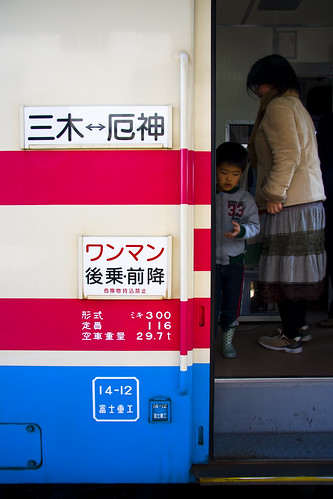
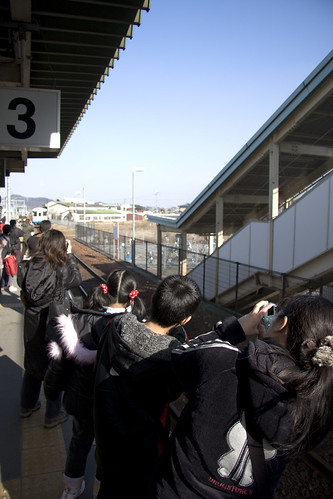
Another aspect of the closure has been the increase of tourism by families, train fanatics, and other curious people. While I was aware of the line, its immediate closure lead me to ride it last monday, a national holiday. The train was packed. At every station there was at least two people, sitting by their cars most of the time, taking photos of the train as it pulled up to the rickety wooden platforms that served as the stations. (Miki Railway runs like much of JR’s rural one-man routes with passengers paying the driver as they exit much like a bus.) In the train I was squished up against the front middle window next to the drivers booth, a prime photo spot. Around me there were a handful of middle aged men and one woman with various high-end SLR cameras. These were the densha otaku--train nerds. Then there were the less hardcore nerds and families using normal point and shoot cameras or their cell phones to capture the moment.
But a moment of what?
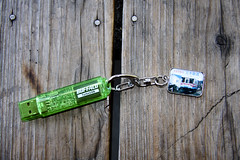
I am a moderate train nerd. I love riding the trains, but I’m definitely not as obsessive as some people. I came to ride this line before it closed. But I realized at that moment as I was couched down and staring out the dirty, fingerprinted window (how can you take a good shot through that), that I was there with a car full of people documenting the death of something. We were riding a dying horse to its stable for the last time. The grandfatherly figure driving the train didn’t seem at all overtly fazed by all these people, but there was a sense of sadness about him. All these people, and it will probably like this until the last day, coming to document his loss of a job--and quite likely an entire lifestyle too. I wondered if he was angry at us, if he thought that we could have saved his train if we just supported it before it was slated for closure. Of course I don’t know the answer to this. The train driver, and every other employee of the Miki Railway were all very, very busy so I didn’t have the chance to ask. You see at the main Miki station, the only station on the line with a staff, there were commemorative stamps and goods for sale. I bought a keychain, but there were phone straps, books, DVDs, toy trains, and rice crackers for sale--many of them sold out. The staff all looked as tired as the weather worn wooden building they were in.
I came to Miki to ride the Miki Railway, I thought it would be a fun experience, but I left with a strange sense of sorrow. Humans revel in watching the despair of others. Is failure more attractive than success? Wether the death of the Miki Railway was predetermined by geographic or economic factors or not the clamor over that death shows that the failure might have an edge.
But there is a bright side of this story. I also took this chance to ride the Hojo Railway. Similar in style and history to the Miki Railway, the Hojo Railway was bright and shining. The stations had the same rickety wooden construction, but appeared to be well maintained. Many flowers and other plants were planted in and around the stations. Signs, seemingly painted by local school children, advertised Kasai city as a “city of flowers.” The riders were upbeat and posters in the train celebrated the high ridership of the local train lines--oddly enough including the Miki Railway--and telling them that the more they used them the lines the more convenient they would become.
On the way home drinking cup-sake as the picturesque landscape of the sun setting on rural Japan slowly rolled by, the sadness I felt earlier had all but left me. The knowledge that community based not for profit mass transit can work made me happy. This time I wasn’t documenting demise, but instead celebrating life.
Link to my route on Google Maps.
Link to the set of photos I took on this trip on flickr.
Tuesday, February 05, 2008
Nigori Sake
Nigori Sake is unfiltered Japanese rice wine so it takes a cloudy milky appearance. The flavor is quite hard to describe, yeasty, quite strange. Sometimes it can be overpowering to the point of not being able to drink it, but this bottle was wonderful. The stuff that makes this cloudy is filtered out for most varieties of Japanese rice wine and is used in cooking. It can be found in any supermarket in Japan.
Discarded Umbrella
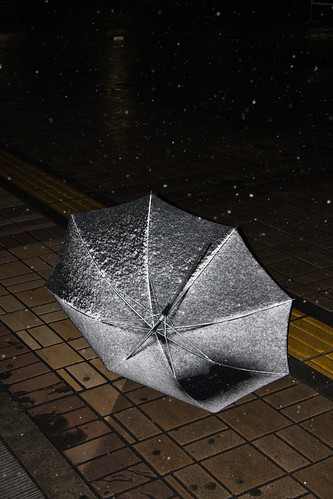
An umbrella, it's handle broken, sits discarded in front of a train station collecting snow on a cold Kobe night.
Sunday, February 03, 2008
Birthday Dinner
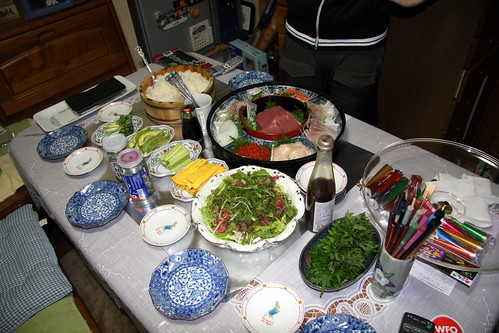
Having a birthday near setsubun is lucky as everyone is in the mood to eat maki sushi.
Tuesday, January 29, 2008
Propaganda Chips
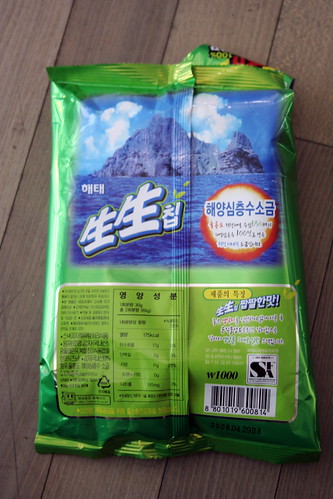
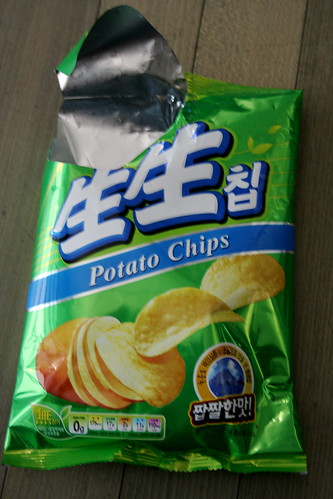
Chips bought at Incheon Int'l Airport, Korea. Do these chips have a picture of the Liancourt Rocks / Dokdo / Takejima on them? Mildly unbelievable. Bringing international disputes to the public on this populist manner reminds me of the stupidity of "Freedom Fries" during the buildup to the Iraq War. Arguments are made black and white and pushed onto the young because the vagaries of the gray area are harmful to the group publishing such propaganda.
No good can come from an international dispute that's fought on a battlefield of video games and potato chips. Well some good can come from it, those chips were pretty tasty.
Friday, January 25, 2008
harry jr?
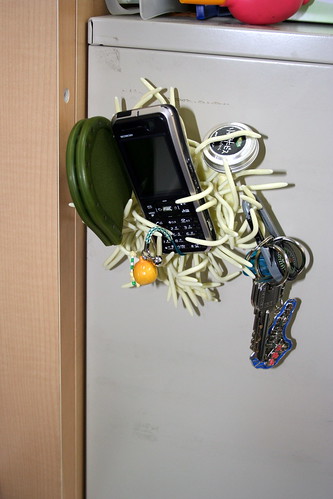
What is it? What does it do? My coworkers call it a sea urchin. I wasn't that sure when I got it. I use it to hold my keys, cell phone, lip stuff, and coin purse, but I often come into work in the morning to find strange objects embedded in its hairs. Dolls, stamps, toys, other things...
A wonderful Christmas gift. Thanks Mom!
Wednesday, January 23, 2008
Winter in Jyuso
I just got around to posting my first day out shooting with my new lensbaby G3. I have to say it was fun, but a
bit freezing walking around with out my gloves on. Focusing the lensbaby will take some getting use to.
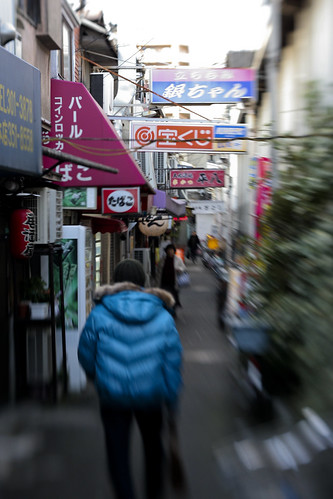
Jyuso is an area of Osaka across the river from the downtown district of Umeda. It's one of the Hankyu line's biggest stations and there's many crowed shotengai (shopping arcades) near the station. Jyuso is also known for it's live house (Fandango) and it's large red light and love hotel district.
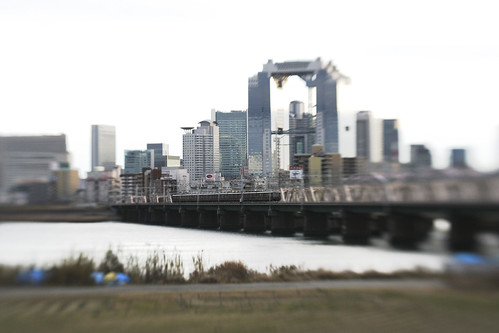
I chose to go here for the shot of the Hankyu train crossing the river with the double tower Osaka Sky Building in the background.
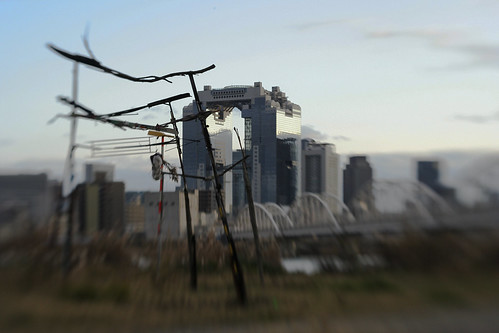
River sides are free game for homeless to set up whole shanty towns. This structure appears to be a patchwork shinto gate, or someone's piece of art possibly set up by one of the invisible homeless.
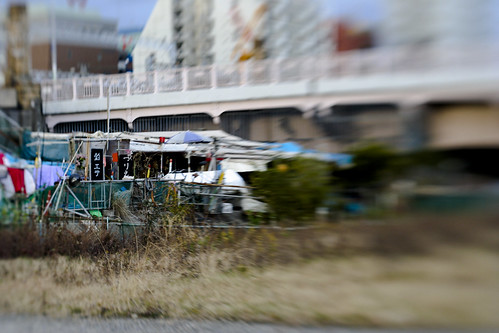
The homeless are so assured that they won't be kicked out that they build fairly large structures they also sell things from their lean-tos. This person has signs advertising fishing bait for sale. The issue of the homeless in Japan is one which I would like to invest more time into studying. I find the construction of their structures to be innovative and visually appealing while also symbolizing various social problems in Japan.
All of these photos can be found in my Winter in Jyuso set on Flickr
Wednesday, January 16, 2008
Saturday, January 05, 2008
I got Boned by United and the Weather!
Wednesday, January 02, 2008
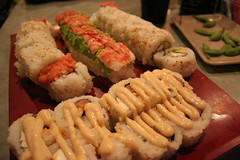
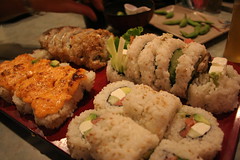
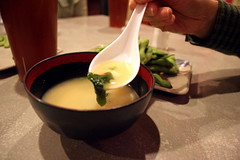
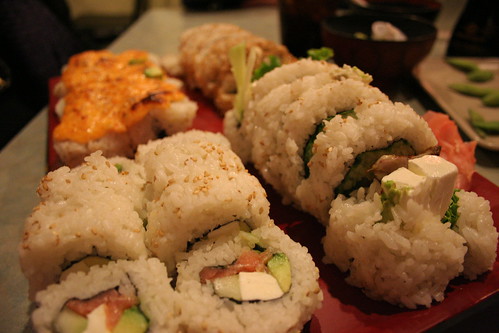
Things I Miss About America: American Sushi?!?!
I donno if I really miss oddball american sushi with its cream cheese, lack of nori and spicy mayo, but it's a fun treat. And what's with the spoon in the miso soup!
These were taken at Sushi Saga in Tucson.
Sunday, December 30, 2007
Things I Miss About America: Mexican Food
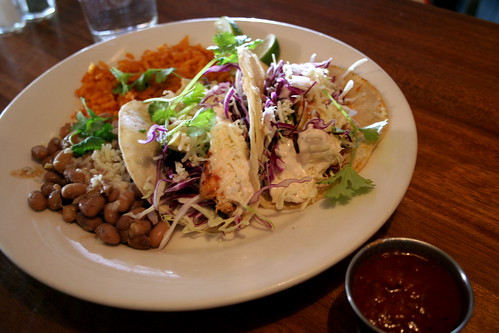
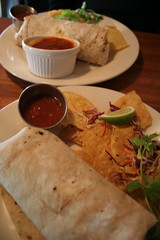
So, if you haven't guessed, I'm in America for a week. So I'm going to focus on some things I miss about America for the next week. Number one: Mexican food in Tucson. Soooo good. We had fish tacos, a pork burrito, and a fish burritos.
This is from the b-line on 4th Ave. in Tucson. おすすめ!
Monday, December 24, 2007
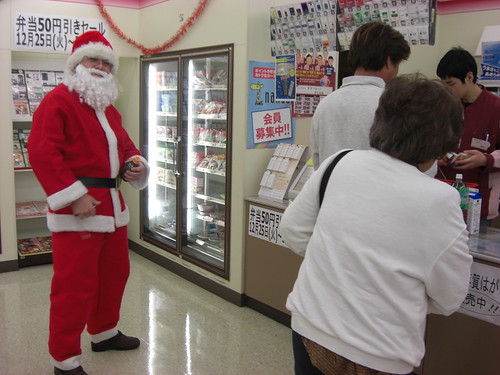
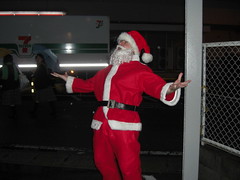
Santa Claus Spotted In Japan, Buying Tea, Saying "Ho Ho Ho!"
It seems that Santa needed a warm pet bottle of green tea today in Hyogo, Japan. Santa also showed his adoption for new technologies, paying for his tea with a Nanako enabled cell phone. But beware this Santa although he looks friendly is known for calling out "Merry Christmas" in his loud jolly voice to unexpecting Japanese folks.
Tuesday, December 11, 2007
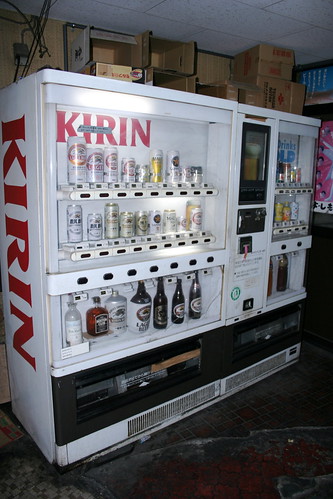
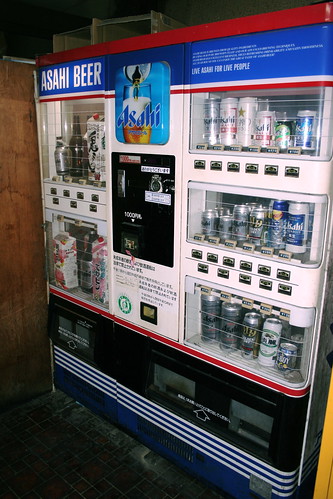
Battle of the vending machines.
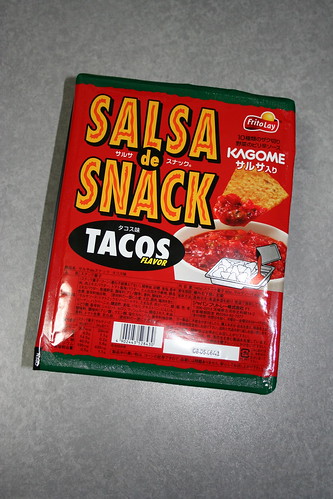
Chips & Salsa... Konbini Style
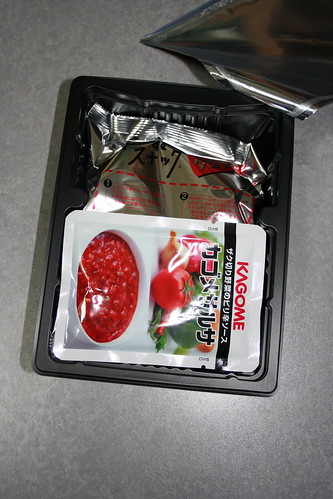
Step 1: Open top. Remove salsa and chip packets.
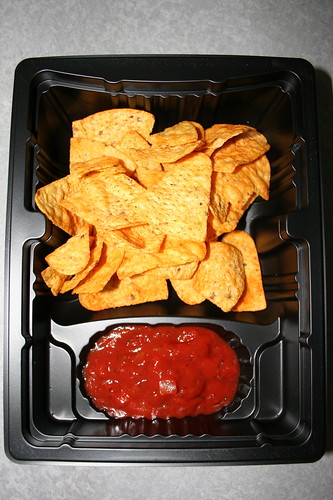
Step 2: Following the directions on the chip packet, open chips and salsa packets. Empty contents into their given places in the tray.